
Introduction
Softgel capsules (also known as soft gelatin capsules) are widely used to deliver nutritional supplements. They are single-piece gelatin shells filled with semi-solid or liquid nutrients.
Unlike hard capsules, softgels are produced and filled in a single continuous process. They can seal sensitive ingredients, such as oils, tightly while allowing easy swallowing.
Here, we’ll examine the softgel capsule production process from raw materials through completion. We’ll additionally check out whether it’s profitable to sell softgel supplements.
Softgel Capsule Manufacturing Process
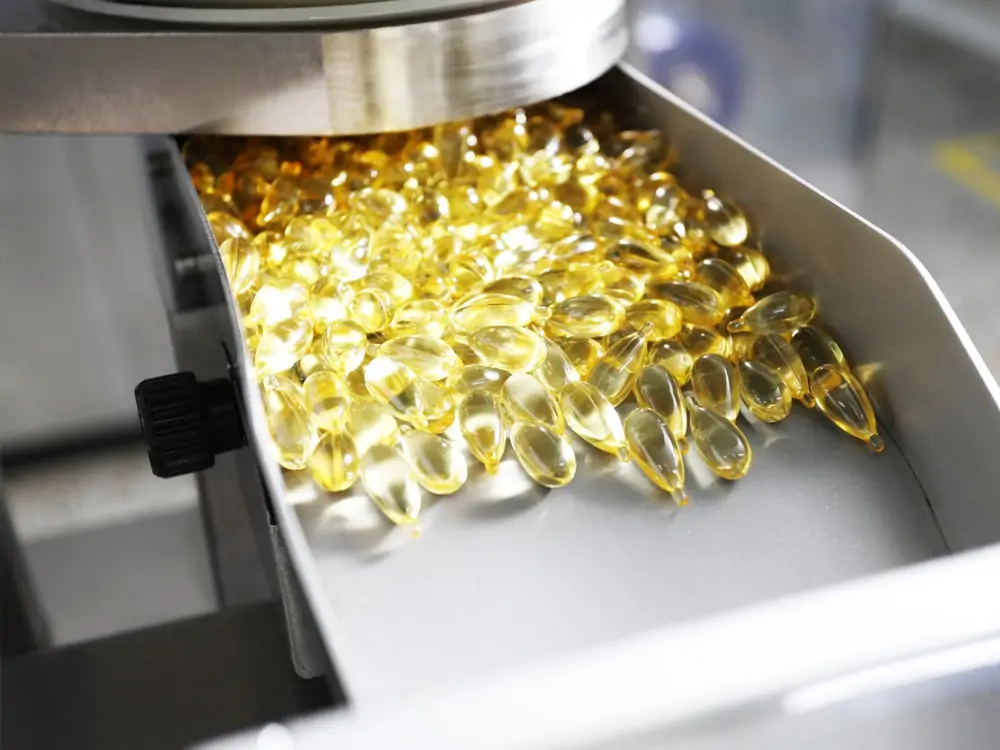
The softgel capsule manufacturing process is intriguing, from concept to finished capsule. These capsules are commercially produced using rotary-die technology.
It allows flawless forming, filling, and sealing integrated in a single operation. That makes it suited for high-volume production. These procedures are particularly standardized across producers.
Here are the essential steps in this fascinating procedure from beginning to end:
1. Gel Preparation
Gel mass preparation is the starting step in the softgel capsule production process. As you see, gelatin gels are thermo-reversible. It implies that they solidify into a gel at room temperature and melt upon heating. This gelatin property is employed throughout softgel manufacturing.
This step entails mixing and heating granulated gelatin and other ingredients (e.g., plasticizers) in warm water. It’s carried out in a gelatin melting tank.
With suitable heat, blending, and vacuum application, the ingredients form into a thickened syrup. It’s called gel mass and is used in the encapsulation process.
At this stage, a color solution may be added during melting. Or it can be through a separate machine.
2. Fill Material Preparation
While preparing the capsule shell, the filling material is also being prepared simultaneously. All active ingredients, solvents, and oils are mixed in specific mixing tanks.
At this point, powders (e.g., vitamins) are milled and separated to avoid large particles. While solids/liquids are blended via:
- Magnetic agitators
- Homogenizers
- High-shear mixers
The aim is to acquire a uniform solution or suspension. The complete filling mixture is sent to the hopper of the encapsulation machine.
3. Encapsulation
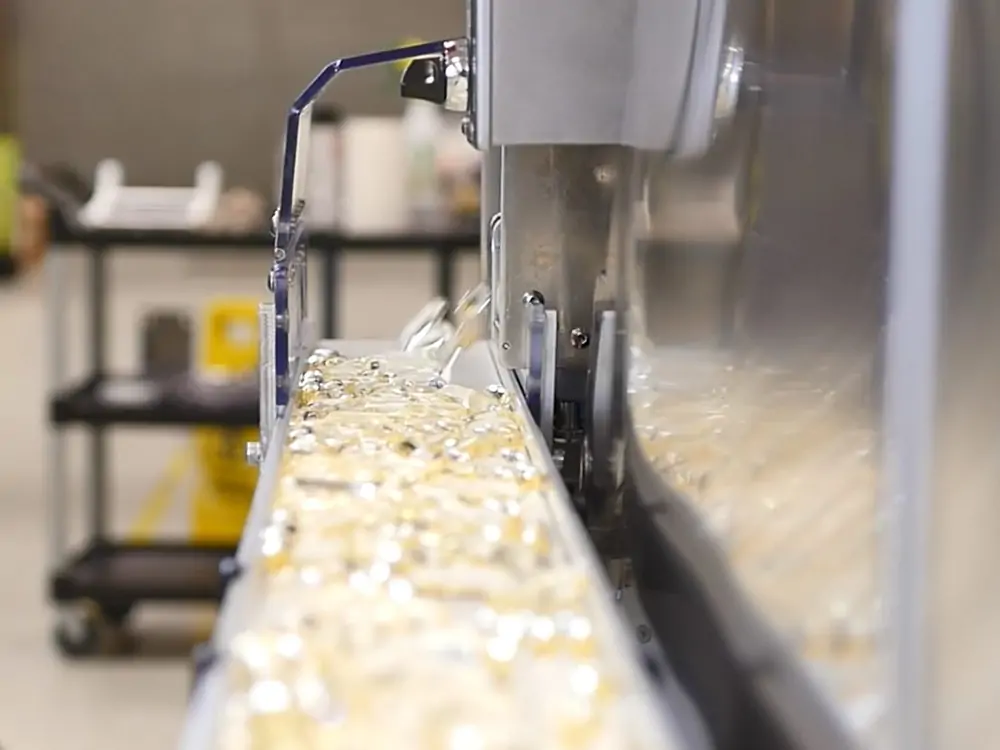
Encapsulation forms the crux of the production process of softgel capsules. Here, a rotary-die machine concurrently forms, fills, and seals them in a single continuous motion.
At this stage, the gelatin mass is transferred to chilled casting drums. As a result, two thin, continual ribbons of gelatin form. It will eventually become the capsule shell.
During this encapsulation procedure, the cast gelatin ribbons are supplied between two revolving die rolls. The capsule fill is measured volumetrically and injected into the pockets forming each capsule.
This step also involves applying a ribbon lubricant to the wet gelatin ribbon. The aim is to enhance smooth transport on the encapsulation machine’s metal parts.
The rotary dies then seal and cut the distinct capsules from the ribbons. At this stage, the capsule shell’s water content is approximately 35-40%.
4. Drying and Curing
The newly produced softgel capsules are soft and warm, with a raised moisture content. They should be dried and cured to lessen their moisture content to approximately 5-10%. That’s typically carried out in two stages.
The first stage involves tumble drying. The capsules are passed into a tumble dryer (a vibratory dryer or a rotating stainless steel drum). Here, humid, warm air passes through them, swiftly removing most of the moisture.
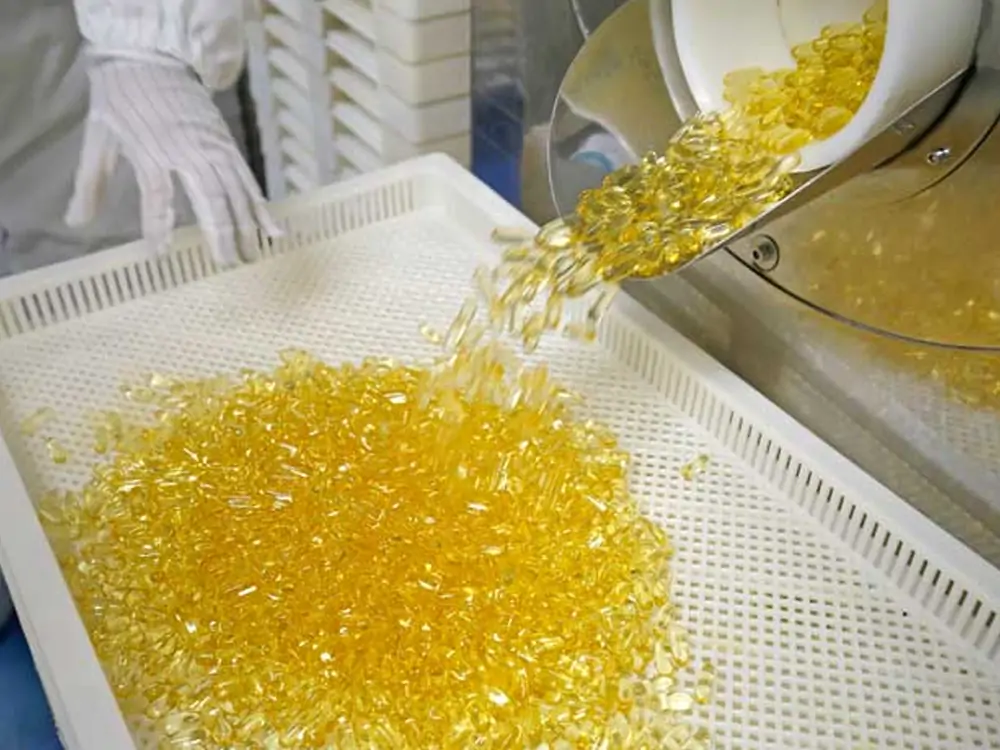
Afterwards, the capsules are spread onto the trays (such as a convection cabinet or tunnel). They are additionally dried in a climate-controlled room. Here, humidity and air temperature are precisely regulated. Thus, the softgel capsules dry without cracking.
All these steps reduce the capsules’ moisture content to the target value stated earlier.
5. Inspection and Finishing
Throughout and after production, softgel capsules are thoroughly inspected. That’s to make certain they fulfil all quality standards.
For instance, technicians check for the following:
- The cast ribbons are inspected for precise clarity, thickness, and lack of air bubbles. That’s before filling.
- The capsules’ fill weight is measured to ensure dosage accuracy.
- The finished capsules are inspected for shape, surface defects, and color consistency.
- Random softgel capsules undergo seal integrity testing. It ensures seals are finished, and capsules won’t leak.
After inspection, such capsules are sorted, printed (by choice), polished, and packaged for distribution.
Is Selling Softgel Supplements Profitable?
Selling softgel supplements is considered a highly profitable business within the broad dietary supplement industry. That’s driven by increased consumer demand for superior bioavailability and convenient, easy-to-swallow supplements.
The global softgel nutritional supplement market is also undergoing substantial growth. According to DataM Intelligence, it attained USD 185.4 billion in 2024. By 2032, it’s predicted to reach USD 358.6 billion. That’s at a Compound Annual Growth Rate (CAGR) of 8.6% during 2025-2032.
Furthermore, the market is seeing cutting-edge encapsulation techniques. Such innovations enhance nutrient absorption, mask taste, and improve stability. It makes them favored across the nutraceutical industry.
As stated before, gelatin is the primary ingredient of softgel capsules. Variations in the availability and price of gelatin can affect the production expenses of these capsules. These, in turn, can affect the profit margins from such products.
Handian Provides Capsule Supplement Manufacturing Services
Concerning softgel capsule production, Handian Nutrition is your dependable partner. We have modern, multiple manufacturing lines and stringent quality control.
We possess the annual capacity to manufacture more than 5 billion soft capsules. We also offer renowned and custom formulations to help your brand thrive.
Contact us for all your softgel capsule endeavors.