Undoubtedly, the global vitamin and dietary supplement market has witnessed ample growth in recent years. According to GlobalData, the market size was estimated at USD 138.2 billion in 2024. It’s projected to attain USD 188.7 billion in 2029. That’s at a 6.4% CAGR (Compound Annual Growth Rate).
Given this, trends — especially rising health consciousness and personalized nutrition — are driving the market forward. Concerning supplement forms, gummies and liquid supplements are emerging as popular segments within the market.
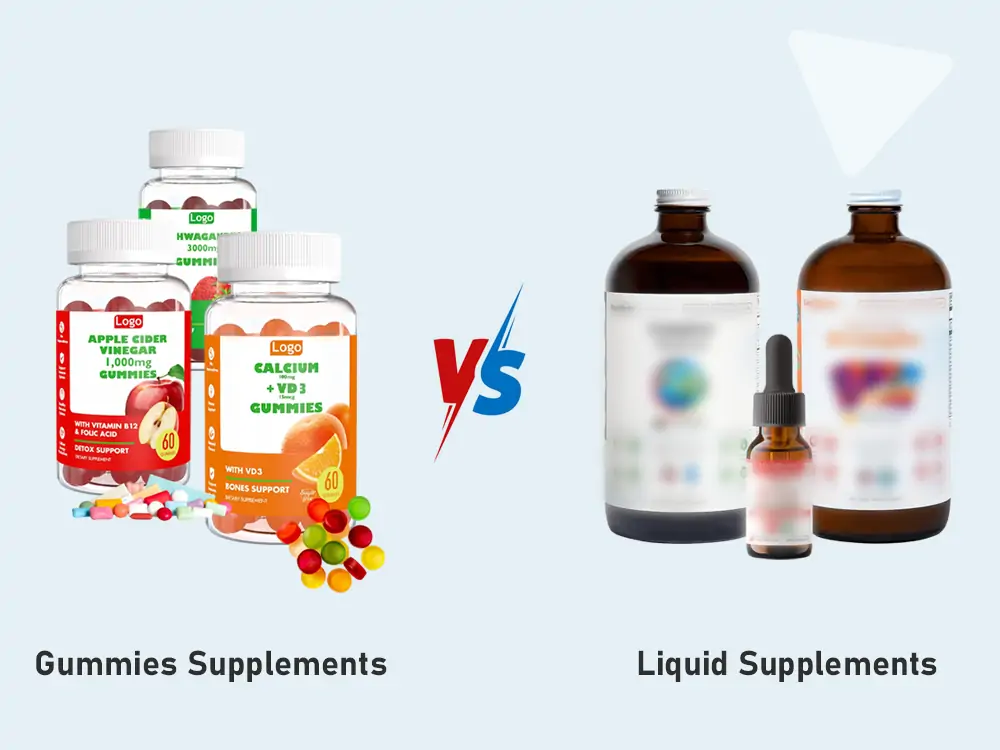
Here we’ll compare these two supplement formats in-depth. We’ll further provide valuable guidance for B2B clients. That encompasses distributors, brand owners, and retailers. The goal is to aid in product selection and market strategy development.
Gummy and Liquid Supplement Market Overview
Both the gummy and liquid supplement markets are witnessing substantial growth. Let’s compare the position of these two thriving markets in greater detail:
Gummy Supplement Market Positioning
Definition
The gummy supplement market refers to a segment in the wellness and health industry. Its focus is on dietary supplements presented in a gummy candy-like format.
The market is undergoing notable growth. That’s owing to augmented consumer demand for palatable and convenient supplement products. These tasty, easily consumable health products serve as alternatives to conventional capsules and tablets.
Furthermore, these gummy products offer functional health benefits across various categories. These encompass immunity boost, sleep, and digestion, among others.
Market Size and Growth Rate
According to Mordor Intelligence, the worldwide gummy supplement market size attained USD 25.74 billion in 2025. By 2030, it’s projected to get to USD 38.12 billion. That’s at a CAGR of 8.17% during 2025-2030.
Target Customers
The target customers of the worldwide gummy supplements market are diverse. They generally encompass the following:
- Adults: Prefer gummy supplements for their convenience, taste, and ease over traditional pills.
- Children: Prefer gummies due to their chewable format and candy-like taste, which offers varied health benefits.
- Elderly individuals: Prefer gummies due to issues swallowing pills and the softer supplement form.
- Women: Prefer gummy supplements for their health advantages, such as beauty from within.
- Vegan consumers: Prefer plant-based gummy supplements.
Liquid Supplement Market Positioning
Definition
The liquid supplement market is a segment of the wellness and health industry. It focuses on the nutritional supplements in liquid form. Such supplements are swiftly absorbable and convenient alternatives to traditional pills.
Akin to the gummy supplement market, the said market is also witnessing elevated growth. Factors, namely surging health awareness and personalized nutrition, drive the liquid supplement market.
Market Size and Growth Rate
According to Mordor Intelligence, the liquid dietary supplement market size attained USD 26.4 billion in 2025. By 2030, it’s forecasted to reach USD 50.1 billion. That’s at a CAGR of 13.9% during 2025-2030.
Target Customers
The target customers of the global supplement market are varied. They generally encompass the following:
- Geriatric Population (Over 65 years): Prefer liquid supplements due to difficulties in pill swallowing and greater bioavailability.
- Athletes and fitness enthusiasts: Prefer liquid supplements for sports nutrition and hydration.
- Adults: Prefer liquid supplements, especially ready-to-drink ones and those offering personalized nutrition.
- Children and Teens: Preferred by parents for easy administration for their children.
Comparison of Gummies and Liquid Supplements
After looking at their respective market positioning, let’s compare these two renowned supplement forms. That concerns some pivotal factors:
1. Manufacturing and Supply Chain Considerations
Both gummies and liquid supplements have distinctive manufacturing and supply chain considerations.
Gummy supplements require specialized equipment for molding and ingredient-binding agents. They also have distinct storage needs, especially concerning temperature and other factors.
Liquid supplements typically involve more complex formulations, hence requiring the use of preservatives. That’s to uphold their shelf life.
Both supplement forms need stringent quality control throughout the fabrication process and supply chain. That’s from raw material sourcing to packaging and storage.
2. Formulation Flexibility and Innovation
Formulation flexibility and innovation in supplement formats aid brands to rise in a competitive market.
As you see, gummy supplements can be formulated with distinct textures, flavors, and functional ingredients. All these options contribute to creating a premium experience for consumers.
Yet, liquid supplements can provide advanced formulations. These can include liposomal delivery for improved absorption.
It’s pivotal to opt for a suitable format innovation. Hence, brands can facilitate premium pricing and build up a strong market position. It’s also imperative to opt for a manufacturer that offers flexibility in customization and formulation.
3. Brand Differentiation Potential
Both gummy and liquid supplements offer distinct brand differentiation potential. That lets brands stand apart from their competitors in the crowded market.
For instance, a gummy supplement brand may differentiate by offering the following gummy features:
- They are a flavorful, chewable alternative to capsules.
- Easy for adults and fun for children who dislike taking pills.
- Being gentle on the stomach with no irritation or bitterness, like some pills.
- Gummies are also available in vegan-friendly, sugar-free options in fun shapes.
Similarly, a liquid supplement brand may differentiate by the following features of such supplements:
- They absorb swiftly, unlike pills that break down.
- They are easy to take for seniors and kids, especially for those with swallowing difficulties.
- Their private label options offer customized dosages, ingredients, and flavors.
4. Costs
The cost of fabricating nutritional supplements can differ substantially depending on the supplement format.
Liquid supplements have varying expenses based on stability requirements and packaging. That’s because they often require preservatives and additional stabilizers to ascertain a longer shelf life. That may augment the production expenses.
Gummy supplements are comparatively more expensive to fabricate. That’s because they require ingredient-binding agents and specialized molds. The aim is to maintain consistency in texture and stability of ingredients.
5. Profits
Liquid supplements typically offer greater profit margins owing to their greater bioavailability and faster absorption. Additionally, they can incorporate more active ingredients.
Their premium quality lets businesses charge higher prices. Concurrently, it permits businesses to uphold customer satisfaction and brand loyalty.
Yet, gummies are not far behind concerning profitability. That’s owing to their greater consumer demand among children and adults. They also have premium pricing for wellness and beauty-focused products.
6. Legal and Compliance
About the flourishing supplement industry, legal and regulatory compliance is fundamental. Both gummy and liquid forms are subject to specific regulations governing labelling, safety, and quality.
For instance, liquid supplements may necessitate further testing to ascertain their stability. Gummies may require specific binding agents to maintain their texture and shape.
Both gummies and liquid supplements must comply with the US FDA guidelines for nutritional supplements. They must also follow cGMPs (current Good Manufacturing Practices).
Gummy Supplement Market Advantages
The following are some worthwhile gummy supplement market advantages:
1. Advancements in Product Formulations
The rise of the gummy supplement market presents a myriad of opportunities to introduce functional gummies. That can be attributable to advancements in product formulations.
These gummies can address varying health concerns, including gut health, sleep issues, and skin health.
Moreover, the market also presents opportunities to develop dual-layer gummies. Such gummies combine varied health benefits into a single product. That markedly appeals to consumers aspiring for multifunctional supplements.
2. Reach New Customers Worldwide
The rising gummy supplement market enables manufacturers, retailers, and distributors to reach new consumers.
That, in turn, is owing to the rise of e-commerce platforms. It enables consumers to buy gummy supplements online effortlessly. According to Research & Metric, approximately 52% of gummy supplement purchases come from online sales channels.
3. Achieve the Consumer’s Convenience and Delightfulness
Another notable advantage of the gummy supplement market is achieving consumer convenience and delight.
As you can see, consumers seek enjoyable and convenient ways to take their daily supplements. The tasty, chewable format of gummies appeals to a broad demographic, from adults to children. It’s especially applicable to those who want to eliminate the discomfort of swallowing pills.
4. Innovation in Sustainable Packaging
Sustainability is gradually becoming a decisive factor influencing consumer buying decisions. Research indicates that consumers of gummy supplements strongly opt for products with sustainable packaging.
Thus, the gummy supplement market presents the ideal prospect to foster innovation in sustainable packaging. Such innovation encompasses the incorporation of recyclable materials and plant-based polymers.
According to MarketResearch.com, up to 81% of consumers in the UK demand sustainable packaging. That’s a worthwhile jump towards eradicating plastic waste.
Liquid Supplement Market Advantages
The following represent some notable liquid supplement market advantages:
1. Achieve Unique and Competitive Product Differentiation
The liquid supplement market presents businesses with a distinct opportunity for product differentiation. Hence, liquid formulations are a source of high bioavailability and act as a versatile format.
They are suitable for addressing specified health concerns, for instance:
- Beauty
- Cognitive function
- Immune support
Moreover, such liquid formulations offer flexibility in packaging and flavoring. It enables the development of the finest, personalized products that are compelling to niche markets.
2. Create Value with Ready-to-Drink Dietary Supplements
The introduction of ready-to-drink dietary supplements will create value for liquid supplement businesses. That’s one of the notable advantages of the surging liquid supplement market.
Ready-to-drink supplements offer a higher nutritional value and are well-suited for storage and use. They also come in smaller quantities and can be easily carried around.
Such nutritional supplements are expected to become substantially popular, specifically in developing countries. That’s also due to the growing health consciousness among people of different ages.
3. Take Advantage of Advanced Nutrient Delivery Methods
The market offers a unique opportunity for businesses to leverage advanced nutrient delivery methods. That encompasses nanoemulsions and liposomal encapsulations, which enhance nutrient absorption and bioavailability.
Such methods make the liquid supplements more effective.
Conclusion
Selecting the ideal supplement format is crucial for businesses to thrive in the prospering supplement market. Both supplement formats, whether gummies or liquid, have their share of advantages.
The fitting format aligns with your product formulation, marketing strategy, and target audience.
Moreover, Handian Nutrition provides flexible gummy manufacturing solutions to fulfill your unique business’s requirements. We inspire you to interact with us and get a quote.